Indoor air quality (IAQ) in your home affects comfort, cleanliness, and how your house feels day to day. Most homeowners think about dust first, but dust is only one part of the picture.
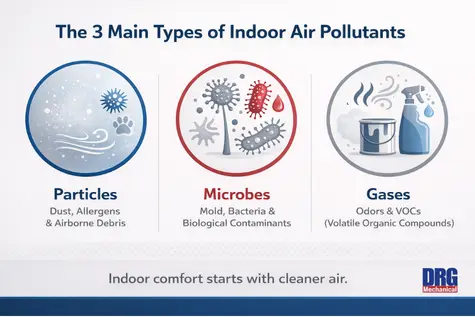
The quality of the air in your home usually comes down to three main categories:
- Particles (dust, allergens, pollen)
- Microbes (mold, bacteria, viruses)
- Gases (odors and VOCs)
Each behaves differently. Because of that, each often requires a different solution.
Understanding what is actually in your air is the first step toward better comfort and healthier indoor air.
1. Particles: Dust, Allergens, and Airborne Debris
Particles are the most visible indoor air quality issue. These can include:
- Dust
- Pollen
- Pet dander
- Smoke particles
- Outdoor air pollution
- Construction dust
Some particles are large enough to settle quickly. However, many smaller particles can stay suspended in the air and continue circulating throughout the home.

According to the EPA Indoor Air Quality Guide, fine particles can remain airborne indoors, especially when HVAC systems are operating.
That is one reason dust often seems to return shortly after cleaning.
Common Signs Particle Levels May Be High
- Dust buildup on surfaces
- Allergy symptoms indoors
- Dust around vents
- Air feeling stale
- Frequent filter changes
Common Misunderstanding: “I Just Need a Better Filter”
A lot of homeowners assume improving indoor air quality is as simple as upgrading their furnace filter.
While higher-rated filters can capture smaller particles, they also restrict airflow. If your HVAC system is not designed for it, that can reduce performance and comfort.
Most standard filters (like MERV 6–8) are designed to protect your HVAC equipment and capture larger particles like dust and pollen — not act as a full air-cleaning solution.
That is why indoor air quality often involves more than just a filter. It usually comes down to airflow, humidity control, and air treatment working together.
Want to improve humidity and comfort as well? Read: Whole-Home Humidity Control: What Level Feels Comfortable and Helps Prevent Mold?
Solutions That May Help With Particles
- Improved filtration
- Air quality devices
- Better airflow
- Reducing dust sources
Some homeowners also choose to install air quality devices designed to help reduce airborne particles.
At DRG Mechanical, two options homeowners often consider include:
- Clear Sky Ionizer
- REME HALO Whole-Home Air Quality System
These systems are installed into the HVAC system and designed to help improve overall indoor air conditions.
Learn more: How Ionization Improves Indoor Air Quality
2. Microbes: Mold, Bacteria, and Biological Contaminants
Microbial contaminants are another major indoor air quality factor. These include:
- Mold spores
- Bacteria
- Viruses
- Dust mites
These contaminants often grow or increase when moisture levels are too high.
According to the CDC, moisture and humidity create conditions where mold can grow indoors.
That is why humidity control is one of the most important parts of indoor air quality.
Common Signs Microbial Air Quality Issues
- Musty smells
- Humidity issues
- Condensation on windows
- Allergy symptoms indoors
- Basement dampness
Solutions That May Help
- Humidity control
- Whole-home dehumidifiers
- Ventilation improvements
- Air quality devices
Whole-home humidity control is often one of the most effective ways to reduce conditions that allow microbial growth.
Read Next: Iowa Summer Humidity
3. Gases: Odors and VOCs
The third category of indoor air quality is gases. These are often harder to notice but can still affect comfort.
Gases may include:
- Cooking odors
- Cleaning products
- Paint and building materials
- Furniture off-gassing
- Household chemicals
The EPA notes that volatile organic compounds (VOCs) can come from many everyday household items.
Many of these gases are not always visible, but they can contribute to indoor air quality concerns.
Common Signs Gas / VOC Issues
- Lingering odors
- Stale air
- Headaches or irritation
- Strong smells after cleaning or painting
Solutions That May Help
- Ventilation improvements
- Air quality devices
- Source control
- Humidity control
Different homes require different approaches depending on the sources inside the home.
Considering indoor air quality upgrades? Indoor Air Quality Products to Consider
IAQ Is About More Than One Product
At DRG Mechanical, we focus on understanding what is actually happening in your home before recommending equipment.
Sometimes the solution is humidity control. In other homes, airflow is the issue. For others, an air quality device may help.
The goal is simple: better comfort and healthier indoor air.
Learn More About Improving Indoor Air Quality
Iowa Summer Humidity: How Corn Makes Home Feel MoreHumid
Is An Ionizer Right for My Home?
Indoor Air Quality Buying Guide
Improve Indoor Air Quality with DRG Mechanical
If your home feels dusty, humid, stale, or uncomfortable, DRG Mechanical can help identify the cause and recommend practical solutions.
We provide indoor air quality solutions throughout Sioux Falls, surrounding Sioux Falls Metro, northwest Iowa, and nearby rural communities.
Schedule Service or Learn More About Indoor Air Quality Solutions